The Vital Role of the Mind-Body Connection in Understanding Consciousness
"Is consciousness purely cerebral? Discover the vital role of the mind-body connection in defining the self. Explore the science of embodied cognition and how physical experience shapes human awareness."
Marie Tolman I Master Holistic Resilience Coach
12/6/20253 min read
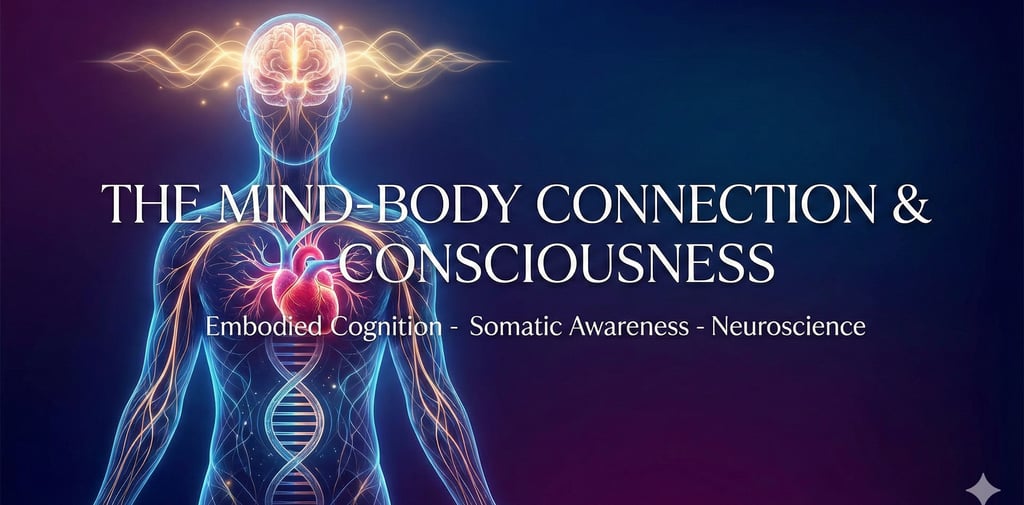
🌌 The Vital Role of the Mind-Body Connection in Understanding Consciousness
A Holistic Exploration of Awareness, Embodiment, and Human Experience
Consciousness—the felt sense of being aware—is one of the most profound and mysterious aspects of human existence. It’s not just a cognitive function or a philosophical puzzle; it’s a lived experience. And to truly understand it, we must look beyond the brain alone. We must honour the intimate relationship between mind and body.
The mind-body connection offers a powerful lens through which we can explore consciousness—not as a disembodied phenomenon, but as a dynamic interplay of thoughts, sensations, emotions, and physical processes. In this piece, we’ll journey through key dimensions that illuminate this connection: embodied cognition, neural correlates, psychosomatic interactions, altered states, therapeutic interventions, and philosophical reflections.
🧠✨ Embodied Cognition: Thought Begins in the Body
Cognition doesn’t float above the body—it’s rooted in it.
Embodied cognition teaches us that our mental processes are shaped by our physical experiences. The way we move, breathe, and hold ourselves influences how we think, feel, and respond to the world.
A slouched posture can reinforce feelings of defeat.
A smile can trigger neurochemical shifts toward joy.
Movement can unlock insight and emotional release.
This embodied intelligence is foundational to understanding consciousness. It reminds us that awareness is not just mental—it’s somatic, relational, and sensory.
🧬 Neural Correlates: Mapping the Landscape of Awareness
Modern neuroscience seeks to identify the neural correlates of consciousness—the patterns of brain activity that correspond with subjective experience. Through technologies like fMRI and EEG, researchers explore how different regions of the brain communicate and co-activate during moments of awareness, reflection, and emotion.
This scientific inquiry helps us understand:
How self-awareness emerges
How attention and perception are regulated
How altered states shift neural dynamics
Yet even as we map the brain, we must remember: consciousness is more than circuitry. It’s also shaped by meaning, memory, and embodiment.
🌿 Psychosomatic Interactions: The Body as a Mirror of the Mind
The mind-body connection is not a one-way street—it’s a dialogue.
Stress, trauma, and emotional patterns can manifest physically, while physical illness or pain can shape our mental and emotional landscape.
Chronic stress may lead to inflammation, fatigue, or digestive issues.
Grief may show up as chest tightness or disrupted sleep.
A resilient mindset can support immune function and recovery.
Understanding these interactions allows us to approach healing holistically—treating the whole person, not just isolated symptoms.
🌌 Altered States of Consciousness: Expanding the Boundaries
Meditation, breathwork, psychedelics, and extreme physical experiences can shift our state of consciousness—sometimes profoundly. These altered states reveal the plasticity of awareness and the transformative potential of the mind-body connection.
Studies show that:
Meditation can change brainwave patterns and enhance self-awareness.
Psychedelic experiences can dissolve ego boundaries and foster emotional healing.
Somatic practices can access deep layers of memory and insight.
These states remind us that consciousness is not fixed—it’s fluid, expansive, and deeply influenced by how we engage the body.
Mind-Body Interventions: Healing Through Integration
Mind-body practices are not just wellness trends—they’re ancient tools for transformation.
Yoga, mindfulness, biofeedback, and expressive therapies leverage the mind-body connection to support healing, regulation, and resilience.
Mindfulness cultivates present-moment awareness and emotional clarity.
Yoga integrates breath, movement, and intention to restore balance.
Biofeedback teaches us to regulate physiological responses through awareness.
Creative therapies allow the body to express what words cannot.
These interventions honour the wisdom of the body and empower us to participate actively in our healing.
🧠🌌 Philosophical Reflections: Consciousness Beyond Dualism
The mind-body connection also invites us into deeper philosophical inquiry.
Is consciousness purely physical? Is it emergent, transcendent, or something else entirely?
Scientific exploration challenges traditional dualism and opens space for integrative models—where consciousness is seen as both embodied and expansive. These questions touch the heart of what it means to be human, and they invite us to consider:
The nature of subjective experience
The relationship between brain, body, and soul
The possibility of a unified framework for understanding reality
🌈 Conclusion: Consciousness as a Living Dialogue
To understand consciousness, we must embrace the mind-body connection—not as a theory, but as a lived truth.
From embodied cognition to altered states, from neural pathways to emotional healing, this connection offers a multidimensional map of awareness. It reminds us that we are not just thinking beings—we are feeling, sensing, moving beings. And our consciousness is shaped by every breath, every heartbeat, every moment of presence.
By honouring this connection, we open the door to deeper healing, richer understanding, and a more compassionate way of being.